Your Ikigai Explained: Simple Ways to Feel Alive Again
Read time: 10 minutes
If you’re wondering how to find your ikigai, you’re not alone and the answer might surprise you. You wake up and check your phone, then answer emails. Make coffee. Work through your to-do list. Scroll before bed. Repeat.
You’re doing all the right things by staying productive, paying your bills, showing up and yet you can’t shake the sense that something feels slightly off. Like life’s happening to you, not through you. Like you’re going through the motions of a script someone else wrote.
If that feeling sounds familiar, you’re not alone. And the Japanese have a word for that gap between simply living and truly feeling alive: Ikigai.
Quick Summary: Ikigai is your “reason for being”—found at the intersection of what you love, what you’re good at, what the world needs, and what you can be paid for. You don’t find it through dramatic epiphanies or career changes. You discover it by noticing what quietly energizes you, tracking your curiosity, and testing small actions that help others. It’s about meaning in everyday moments, not metrics. This is how to find your ikigai and feel alive again—even when nothing else has worked.
What Ikigai Really Means
How to find your ikigai: What does it mean?”
Let’s start with the basics.
What: Ikigai (pronounced “ee-kee-guy”) literally translates to “reason for being.” It’s your purpose, your meaning, the thing that makes you want to get out of bed in the morning—not because you have to, but because something inside you quietly wants to.
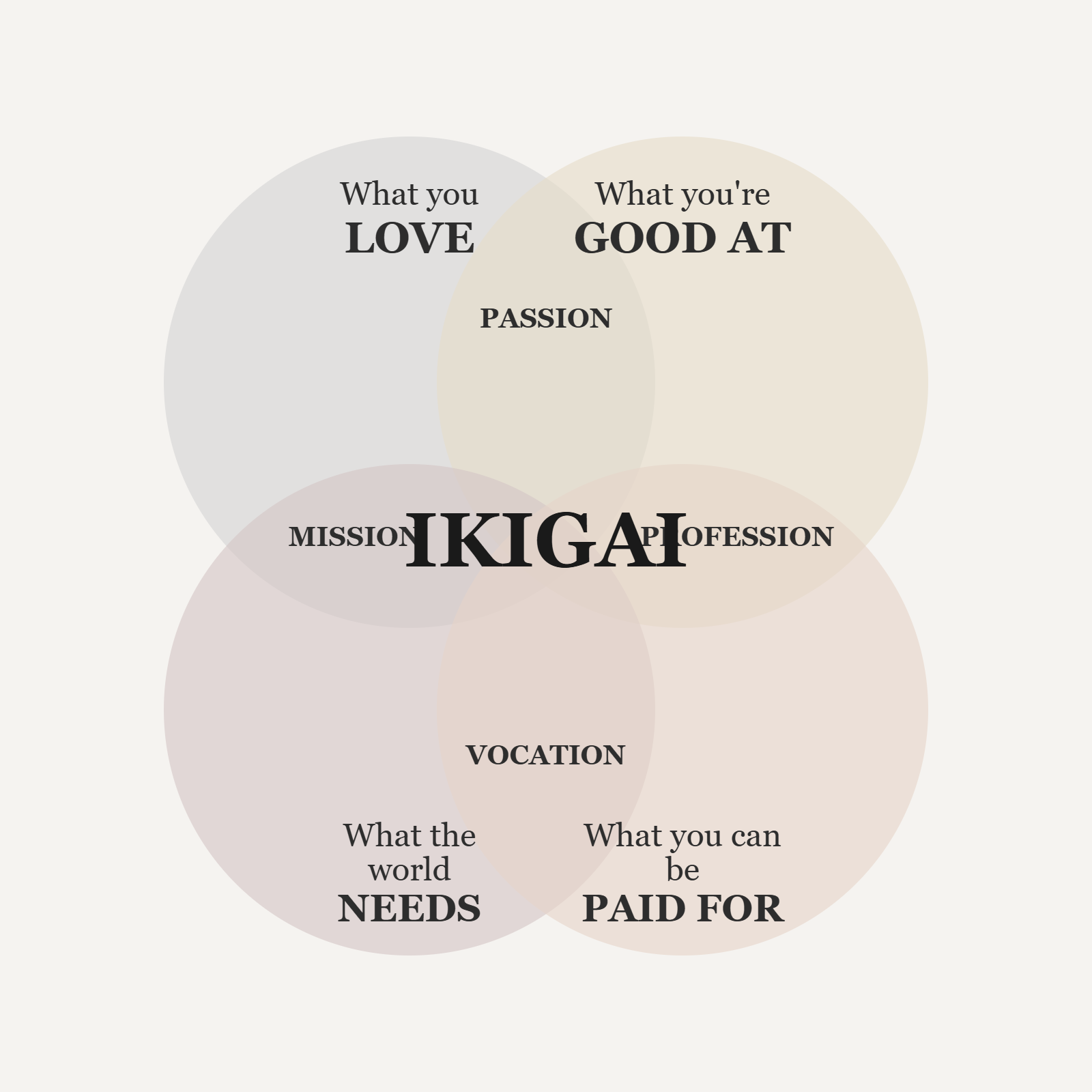
How: Traditionally, Ikigai is found at the intersection of four elements: what you love, what you’re good at, what the world needs, and what you can be paid for. Picture a Venn diagram where all four circles overlap—that sweet spot in the center? That’s your Ikigai.
Action: But here’s the important part: you don’t “find” Ikigai overnight like discovering buried treasure. You notice it by paying attention to what quietly energizes you each day. It’s less about a dramatic revelation and more about subtle recognition.
How to Find Your Ikigai: It’s Not About Your Career
Of course, once you know what Ikigai means, the next question naturally appears: how to find your ikigai in real life, especially if you’re not planning to quit your job.
Do I need to quit my job to find my ikigai?
Somewhere along the way, Western culture turned Ikigai into a productivity optimization tool. We made it about career planning, LinkedIn profiles, and finding the “perfect job.” But its roots run much deeper than that.
In Japan, many people’s Ikigai has nothing to do with money or professional achievement. It’s gardening in the early morning light or maybe teaching a neighbour’s child to read. Creating pottery that no one will ever buy. Preparing meals that bring family together or helping the elderly community members with their groceries.
Ikigai isn’t about achieving something impressive. It’s about meaning, not metrics. It’s about the quiet contentment that comes from doing things that matter to you, in ways that connect you to something larger than yourself.
The point isn’t to achieve Ikigai like it’s a finish line you cross. It’s to live closer to it, day by day, choice by choice.
And here in the UK, more people are rediscovering that truth. From the grey Monday commute to quiet moments in the garden, Ikigai can be found in simple acts that bring a sense of calm purpose a walk by the canal, helping a neighbour, or sharing something meaningful over a cuppa.
How to Find Your Ikigai: A Simple Three-Step Process
So if Ikigai isn’t about chasing the perfect career, where do you even begin?
If you’re thinking “that sounds nice, but I have no idea where to start,” try this simple three-step reflection. Learning how to find your ikigai starts with small observations, not grand gestures.
Step 1: Notice Energy
Pay attention to when you feel quietly content or fully absorbed. Not manic productivity energy—we’re talking about that calm, focused state where time seems to move differently. When you look up and three hours have passed but it felt like twenty minutes. That’s a clue.
Maybe it’s when you’re explaining something to someone and watching them understand or it’s when you’re working with your hands. It could be during conversations where you’re truly listening, not just waiting for your turn to talk.
Step 2: Track Curiosity
What topics or activities do you keep returning to, even when no one’s watching? What do you read about for fun? or YouTube rabbit holes do you fall down? If no one ever saw the results what would you be doing?
Your curiosity is often smarter than your conscious mind about what matters to you. It’s not random—it’s pointing toward something.
Step 3: Test Alignment
This week, try one small action that matches both what you love and what helps others—even in a tiny way. If you love writing, leave an encouraging comment on someone’s blog. If you’re drawn to teaching, explain something to a colleague who’s struggling. and if you find joy in creating beauty, tidy up a shared space at work.
The key word is small. You’re not launching a nonprofit or changing careers. You’re just testing whether the overlap between your interests and others’ needs creates that quiet sense of rightness.
You can even link this habit of testing small actions to other practices you’ve explored, like habit stacking. The smallest change, done consistently, can open unexpected doors toward meaning.
What If I Don’t Have a Passion?
How to find your ikigai without a burning passion
That’s your Inner Critic talking, pretending that purpose should look dramatic and obvious. That unless you have some burning, singular passion that you’ve known since childhood, you’re doing life wrong.
Here’s the truth: most people’s Ikigai doesn’t arrive as a lightning bolt of clarity. It starts as a whisper. A small preference. A gentle pull toward something that feels a little more right than everything else.
Why do other people seem to have it figured out?
If you’re looking around at people who seem to have their purpose all figured out, remember: you’re comparing your behind-the-scenes confusion to everyone else’s highlight reel. Most people are quietly figuring it out as they go—they just don’t post about the messy middle part.
What if I used to feel passionate but now feel numb?
Maybe you used to feel excited about things but now everything feels flat. That numbness isn’t permanent—it’s often just a sign you need to create space for something new. When life gets busy or stressful, we sometimes shut down our curiosity as a survival mechanism. It’s still there, waiting.
You don’t need to have it all figured out. You don’t need to know your “one true calling.” Your only job right now is to listen for what feels quietly right—not perfect, just more right than the alternative.
Sometimes learning how to find your ikigai is less about discovering some hidden truth about yourself and more about giving yourself permission to pay attention to what you already, on some level, know.
If perfectionism has ever kept you frozen, you might find this post helpful—it’s all about starting messy, even when you don’t feel ready.
The Science Behind Purpose
Does having a sense of purpose actually improve your health?
And while all of this may sound philosophical, there’s real science to back it up.
A 2017 study published in Psychological Science found that people who reported a strong sense of purpose had better health outcomes, lower stress levels, and even lived longer. Other research has linked purpose to improved sleep, reduced risk of cardiovascular disease, and greater resilience in the face of challenges.
In simpler terms: feeling your life has meaning literally supports your body and mind. Purpose isn’t a luxury or some abstract concept it’s a fundamental human need, like connection or safety.
When you’re living in alignment with what matters to you, your nervous system relaxes. Your immune system functions better. Your brain processes stress differently. You’re not just happier, you’re healthier too.
How to Find Your Ikigai Today: Simple Daily Practices
Ready to start exploring? These aren’t vague self-development goals—they’re small, specific practices you can try today.
Practice 1: Write down three activities that make time disappear
Don’t censor yourself. Include things that seem “unproductive” or “pointless.” If organizing your bookshelf by color makes time stop, write it down. If researching random historical events captivates you, write it down. If helping friends work through relationship problems energizes you, write that down too.
Practice 2: Do one of them intentionally this week
Not as a break or a reward after you finish your “real” work—as something that matters in its own right. Schedule it like you would a meeting. Give it space and attention.
Practice 3: Reflect on how it feels—not what it achieves
After you do it, pause and notice. Did you feel more like yourself? More present? More connected to something that matters? You’re not looking for measurable outcomes here what your doing is you’re listening for that quiet sense of rightness.
If this reflection feels good, continue exploring it through journaling. You could even combine it with your reflections on how to beat the winter blues in the UK—because noticing joy and light in small things is part of both practices.
Three Actions You Can Take Right Now
How to find your ikigai: What can I do right now?
Want to start even smaller? Here are three things you can do right now:
1. Ask yourself: “When do I feel most alive?” Not happiest, not most successful, most alive. When do you feel most like the person you actually want to be?
2. Spend five quiet minutes journaling that answer. No structure, no rules. Just write whatever comes up. You’re not looking for the perfect answer, you’re creating space for something to emerge.
3. Share a small act of kindness. Text someone you appreciate. Help a stranger with directions. Leave a genuine compliment. Purpose often hides in connection, in the moments when we move beyond ourselves and toward others.
This is just the beginning. Subscribe to keep the conversation going
How I Found Mine
How long does it take to find your ikigai?
A year ago, at 44 years old, I had no idea what Ikigai was. I’d just bought my first self-growth book, desperately hoping it would give me answers. The problem? I had no passions. Nothing that made me want to jump out of bed. Nothing that felt like “my thing.”
So I did what the books said: keep going, keep growing, you’ll find your way. But my way to what?
Nothing was changing. I was a reseller—had been for 20 years. The money was fine. But some mornings, I’d sit in my car in the driveway before going inside to photograph another box of inventory, and I’d think: Is this it? Is this all there is?
Twenty years of packing boxes, of tracking numbers. Twenty years of… nothing that mattered.
Here’s what I learned: doing the same thing I’d always done was only going to give me the same results.
What was the turning point?
I started small. I began walking for the health benefits and listening to podcasts. And somewhere in those walks, on a Tuesday morning listening to someone talk about purpose, I stopped mid-stride and actually said out loud: “I want to help people feel less alone.”
A dog walker gave me a strange look. I didn’t care. Something had shifted.
I realized what tugged at my heart—what actually made me feel something—was helping others. Especially people struggling with their mental health, fitness, and diets when I knew there was another way.
That’s when I started this blog. It gets me up in the morning now. It’s my purpose. I’m not making money. I have few readers right now. But if I help one person? That’s my Ikigai.
How to find your ikigai when it’s already there?
I also realized I’d been looking for some big, dramatic moment when my reason for living was already there: my family, my new grandson. There’s an Ikigai for all of us—maybe we’re just overlooking it.
Here’s what I wish someone had told me: You don’t need to find this huge, world-changing purpose. Sometimes it’s the little things. Sometimes it’s right in front of you. And sometimes, the act of searching—of growing, of trying—is the path.
Want to Go Deeper?
If this concept resonates with you and you want to explore it further, I highly recommend Ikigai: The Japanese Secret to a Long and Happy Life by Héctor García and Francesc Miralles. The authors traveled to Okinawa, Japan—home to some of the world’s longest-living people—to interview centenarians and uncover the secrets to their longevity and happiness.
The book beautifully weaves together their stories, practical wisdom, and research-backed insights about finding purpose. It’s been translated into over 60 languages and has helped millions of readers worldwide discover their own sense of meaning. Just to add i have no affiliate to this book I just genuinely loved it.
How to Find Your Ikigai: Common Questions Answered
Still have questions? I’m building a library of resources on purpose, meaning, personal growth, and everyday mastery. Here are some related topics I’m exploring:
How to know if you’re living closer to your ikigai
The difference between passion and purpose (and why it matters)
What to do when your ikigai changes over time
Small daily practices that reveal your reason for being
Want these insights delivered to your inbox?Subscribe here to join readers who are discovering their path to a more meaningful life.
Mr Critic Moment:
“So you’re saying my Ikigai might just be something small?”
Yes. And that simplicity is exactly what your Inner Critic struggles with. It prefers complicated answers that justify staying stuck.
Try whispering back: Maybe it’s small on purpose. Maybe it’s enough.
And if you don’t have that critical voice, it might show up differently not as words, but as a feeling, a vague unease that hovers whenever you move toward something real.
Journaling Prompts:
What activities make time disappear for you?
When was the last time you felt quietly proud of something small?
What would living closer to your Ikigai look like next week?
Your Choice Right Now
You have two choices right now.
Choice 1: Close this tab. Tell yourself you’ll figure it out later. Keep waiting for the lightning bolt of clarity that never comes.
Choice 2: Right now—not tomorrow, not Monday—write down one thing that made you lose track of time this week. Just one. That’s your breadcrumb.
This is how to find your ikigai: not through perfect clarity, but through one small honest observation at a time.
Which choice are you making?
How to Find Your Ikigai: Coming Home to Yourself
Maybe Ikigai isn’t something you chase down like a goal or manufacture through the right combination of productivity hacks. Maybe it’s something you come back to—again and again, in small moments, through small choices.
Every act of curiosity is a breadcrumb. When you choose what energizes you over what drains you, you’re moving closer. Each time you do something that helps another person and also lights you up inside, you’re walking that path home
You don’t need to have it all figured out today. There’s no need to quit your job, upend your life, or wait for some grand epiphany. Just start paying attention to what quietly calls to you—to what feels, even in small ways, like it matters.
Your Ikigai is already there, waiting. Not in some distant future when you’ve finally “made it,” but in the everyday moments you might be overlooking right now—the ones that make you feel less like you’re performing life and more like you’re living it.
What will you notice first?
About Everyday Mastery
Everyday Mastery blends science, mindfulness, and small daily actions to help you build habits that last.
If you enjoy these posts and want to support the writing, you can buy me a coffee—it keeps the kettle (and the ideas) warm.
Kel is the writer behind Everyday Mastery, where she shares the real, messy, and meaningful process of building habits, resilience, and self-belief from the ground up. Her writing blends ancient philosophy with modern science, always focused on small, practical steps that lead to lasting
Websites store cookies to enhance functionality and personalise your experience. You can manage your preferences, but blocking some cookies may impact site performance and services.
Essential cookies enable basic functions and are necessary for the proper function of the website.
Name
Description
Duration
Cookie Preferences
This cookie is used to store the user's cookie consent preferences.