The Alignment Habit: How to Turn Busy Days into Meaningful Progress
Read time: 10 minutes
Quick Summary: Feeling productive but strangely unfulfilled? This post shows how to reconnect your daily work with your core values, and make meaningful progress even when you can’t choose every task so life feels aligned, not just efficient.
You know that feeling when you’ve ticked every box on your to-do list but still go to bed restless?
Your day looked successful from the outside those meetings done, emails cleared, dinner made and yet something felt off.
You were productive, but not connected.
I used to chase that kind of busyness too. I’d wake up motivated, power through my task list, collapse at the end of the day and well feel nothing. Or worse, that low-grade dread whispering “Is this it? Is this what I’m building toward?”
I tried better systems. More detailed planners. Aggressive time-blocking. But what I really needed wasn’t another productivity hack. It was an alignment habit, a daily practice of making sure the things I spent time on reflected what actually mattered to me.
Here’s the thing: motivation fades fast when your work feels disconnected from your values. You can be incredibly productive yet feel unfulfilled, because productivity measures output, not meaning.
You can power through for a while, but sooner or later, the emptiness catches up.
There’s neuroscience behind this. When your actions align with your values, your brain’s reward system releases dopamine, creating intrinsic motivation and a sense of purpose. Research on dopamine and values-based motivation confirms this mechanism alignment literally engages the brain’s reward circuit, while disconnection leaves you running on willpower fumes.
That restless feeling at the end of a “productive” day? That’s your brain telling you something’s off.
These aren’t goals. They’re your compass the why behind the what.
Dig Deeper
Your positive moments reveal values in action. But there’s another path to discovery: look at where you feel guilt, frustration, or resentment.
These emotions often signal neglected values trying to get your attention. Discomfort points toward what you care about.
Step 2: Audit Your Current Reality
Look at your average week. List the main tasks or responsibilities that fill your time, both at work and at home.
Next to each one, mark it as:
Aligned (fits your values)
Neutral (necessary but emotionally flat)
Off-track (drains you or feels false)
Now ask: What tiny shift could move one task closer to aligned?
Sometimes it’s changing how you approach it, not whether you do it at all.
That question alone can quietly reshape your whole week.
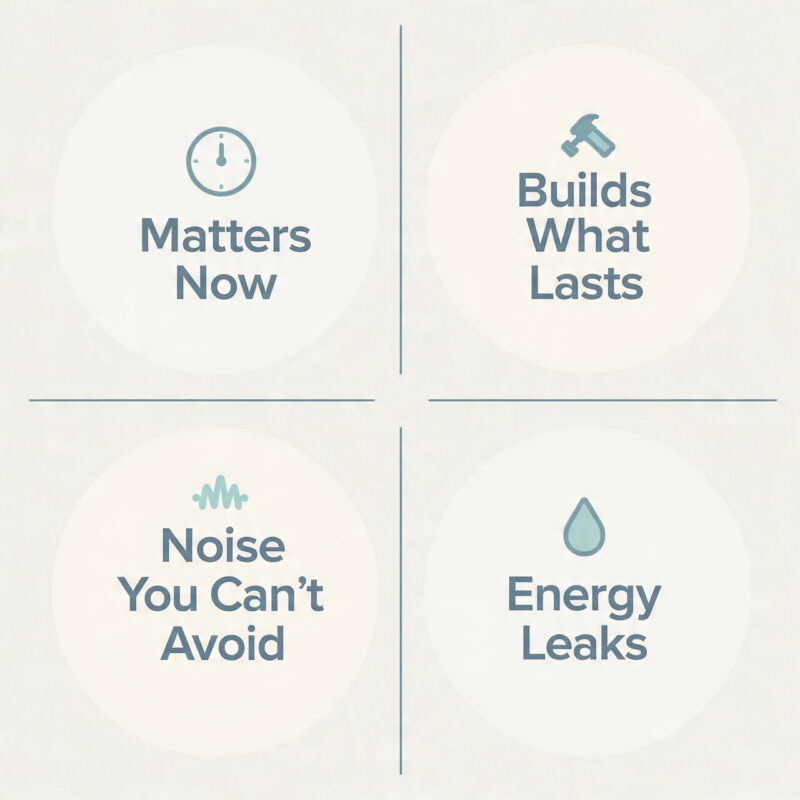
Step 3: The Values Matrix — A Calmer Way to Prioritise
You’ve probably seen the Eisenhower Matrix, a classic productivity framework popularised by President Eisenhower and later expanded by Stephen Covey. It divides tasks by urgency and importance.
But here’s the problem: not everyone can choose their tasks. You can’t just delete work emails or skip the meeting your boss scheduled.
So instead of treating “important” as what others expect, let’s redefine it as what feels meaningful.
Quadrant
New Label
Example
Everyday Mastery Shift
Urgent + Meaningful
“Matters Now”
Submit report with care
Do it well, but calmly.
Not Urgent + Meaningful
“Builds What Lasts”
Exercise, journaling, learning
Protect at least one daily.
Urgent + Doesn’t Nourish
“Noise You Can’t Avoid”
Admin tasks, routine meetings
Reframe: serve with integrity.
Not Urgent + Doesn’t Nourish
“Energy Leaks”
Doomscrolling, gossip, busywork
Limit or batch intentionally.
The aim isn’t to escape the noise it’s to spend more time where life feels meaningful, even in small ways.
Step 4: Reframe What You Can’t Control
You might not love every task, but you can bring your values into how you do it.
Boring spreadsheet? → Focus on accuracy or service.
Difficult client call? → Practise patience or compassion.
Endless meeting? → Look for connection or learning.
The task stays the same. The meaning changes.
This reframing restores autonomy — one of three core psychological needs that fuel intrinsic motivation (along with competence and connection). Studies on psychological flexibility show that when people stay connected to their values even during uncomfortable tasks, they experience greater emotional regulation, adaptability, and well-being.
You’re not changing reality. You’re reclaiming agency within it.
Real-World Example
When I was rebuilding my health, I didn’t always want to meal prep on Sunday afternoons. But when I reframed it through my value of self-respect — “I’m honouring my body by preparing fuel that serves me” — the task transformed. Same chopping. Same containers. Completely different emotional experience.
The work didn’t get easier. The meaning made it worthwhile.
Mr Critic Moment:
“Alignment habit?” he mutters, “You’re lucky if you can align your socks, let alone your values.”
That’s the voice that turns awareness into avoidance, the one that convinces you reflection is indulgent. When that thought shows up, notice it, smile, and keep going. You’re not proving your worth; you’re practising awareness. Mr Critic hates that because awareness dissolves his power.
And if you don’t hear a critic so much as feel one, that tightening in your chest, that quiet resistance before you take action that’s still him, just in another form. Notice the feeling with the same compassion. The moment you do, you’ve already shifted the story.
Step 5: Build Your Daily Alignment Habit
Before you switch off tonight, ask yourself one question:
“What did I do today that reflected my values?”
If you can name even one thing, you’re practising the alignment habit.
Some days you’ll find three examples. Other days, one small moment. Both count. You’re training your brain to look for alignment, and attention shapes reality.
If you want to go deeper into the practice of daily reflection, explore The Stoic Reflection Habit Loop — it shows how a few quiet minutes of honest review can turn awareness into real, lasting progress.
3 Actions You Can Take Today
Write down three values that feel true for you right now
Circle one task today you can approach from that lens.
Protect one “Builds What Lasts” moment — five minutes is enough.
Journaling Prompts:
When did I feel most myself today — and what value was I living then?
Which task felt most draining, and what value might have been missing?
If I lived one value 10 percent more tomorrow, what small action would show it?
Write without editing. Let awareness lead. The clarity that follows is the quiet kind — the kind that sticks.
Everyday Mastery Steps You Can Take Now
1️⃣ Notice before you optimise. You don’t need a new system; you need awareness of what feels off. 2️⃣ Shift the story, not the schedule. Reframing meaning often matters more than rearranging tasks. 3️⃣ Build micro-alignment. One meaningful action a day compounds faster than constant busyness.
Final Thought
I remember the first week I tried this. I found exactly one moment of alignment on Tuesday and felt like I’d failed. But that one moment was the seed.
Once your actions align with your values, you stop chasing motivation. You simply move , because it feels right.
This is your permission slip to start messy. We don’t chase perfect here — we practise progress.
Kel is the writer behind Everyday Mastery, where she shares the real, messy, and meaningful process of building habits, resilience, and self-belief from the ground up. Her writing blends ancient philosophy with modern science, always focused on small, practical steps that lead to lasting
Websites store cookies to enhance functionality and personalise your experience. You can manage your preferences, but blocking some cookies may impact site performance and services.
Essential cookies enable basic functions and are necessary for the proper function of the website.
Name
Description
Duration
Cookie Preferences
This cookie is used to store the user's cookie consent preferences.